Live Chat & Phone Support: Quick Answer
Research shows customer preferences vary considerably by situation. For complicated requests, phone remains particularly important.
Choose Live Chat If…
Your customers mainly need fast answers, product information, website assistance or help while they’re browsing.
Choose Phone Support If…
Customers frequently have complex problems, urgent issues, sensitive conversations or need a more personal interaction.
Choose Both If…
Your business receives a mixture of simple questions, sales enquiries, technical problems and high-value customer conversations.
That last option is often the most practical. Customers shouldn’t have to use the same communication channel for every type of problem.
Which Is Better for Your Business: Live Chat or Phone Support?
Before investing in a customer support system, look at the questions your team handles every day.
| Customer need | Better channel |
|---|---|
| Quick product questions | Live chat |
| Pricing questions | Live chat |
| Website navigation help | Live chat |
| Pre-sales questions | Live chat |
| Lead qualification | Live chat |
| Simple order or status questions | Live chat |
| Complex troubleshooting | Phone |
| Urgent problems | Phone |
| Sensitive complaints | Phone |
| Detailed technical discussions | Phone |
| High-value customer conversations | Phone |
| Customers who prefer speaking to a person | Phone |
| Mixed support requirements | Both |
A good support strategy matches the channel to the problem instead of forcing every customer through one route.
Need a professional team to answer your business calls? Explore our phone answering service for UK businesses.
Phone Answering Service UKWhen Live Chat Is the Better Choice
Live chat can be particularly effective when customers are already on your website and need an answer before taking the next step.
A website visitor might be wondering
- “Which service is right for my business?”
- “How much does this service cost?”
- “Can you help with my specific problem?”
- “How quickly can you get started?”
- “Do you provide support after purchase?”
- “Can I speak with someone about my requirements?”
Why it works
These are excellent opportunities for website live chat because the customer is already showing buying intent.
Live chat can also allow agents to handle multiple conversations, which can make the channel more efficient for straightforward enquiries.
Ecommerce Businesses
Customers can ask about products, availability, shipping, returns, payments or recommendations without leaving the website.
Service Businesses
Potential clients can ask questions about services, pricing, availability and next steps.
SaaS and Technology Companies
Chat works well for product questions, onboarding assistance, account guidance and basic troubleshooting.
Lead Generation Businesses
A proactive chat invitation can turn a visitor who is simply browsing into a qualified sales conversation.
When Phone Support Is the Better Choice
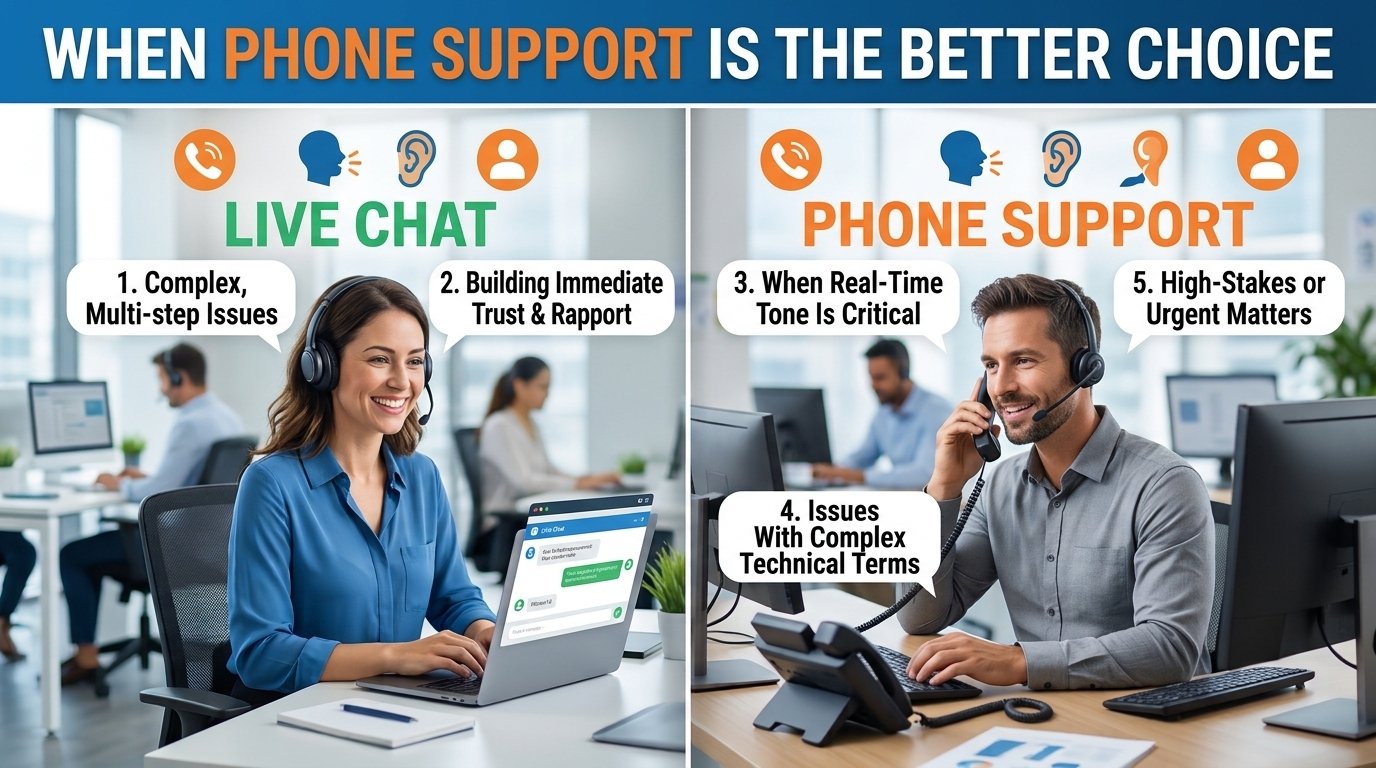
Phone support becomes more valuable as the complexity, urgency or emotional importance of the issue increases. Explaining a complicated technical problem through multiple chat messages can take longer than simply talking to an experienced agent.
Phone works particularly well for
- Urgent customer problems.
- Complex troubleshooting.
- Billing disputes and account problems.
- Complaints requiring empathy.
- High-value customers.
- Detailed consultations.
- Customers who are uncomfortable with digital support.
- Situations where several questions need to be discussed together.
What the research says
Voice support gives agents access to tone, hesitation, frustration and urgency that can be difficult to communicate through text.
One Zendesk study found that 76% of respondents preferred phone for complicated requests, compared with 43% for live chat.
Looking for an outsourced bureau to handle calls on behalf of your business? See our telephone answering bureau service.
Telephone Answering Bureau UKLive Chat & Phone Support: Cost and Efficiency
One of the biggest reasons businesses consider live chat is operational efficiency. A phone agent normally focuses on one customer at a time, while a trained chat agent may be able to manage several conversations simultaneously, depending on the complexity of the enquiries and the quality of the support workflow.
That doesn’t mean chat is always cheaper
If your chat team is overloaded, response times become slow. If customers have complicated issues that require long conversations, the expected efficiency advantage can disappear.
The real question
How much does it cost your business to successfully resolve each type of customer request?
These metrics tell you much more than simply comparing the price of chat software with the cost of a phone system.
Need extra call capacity for busy periods or staff absences? Explore our temporary answering service.
Temporary Answering Service UKLive Chat & Phone Support for Sales and Lead Generation
This is where live chat can become more than a customer service tool. A website visitor may be interested in your service but still have one unanswered question. If there is no easy way to get help, they may leave and continue searching elsewhere.
A well-managed sales live chat can help by:
Live chat
Supports both customer service and conversion optimisation. Proactive chat is especially useful because agents can start conversations while potential customers are browsing.
Phone support
Once a qualified prospect calls, an agent can have a much deeper conversation without the limitations of text. For expensive services, consultations, B2B solutions and high-value purchases, phone calls can be particularly useful for converting qualified leads.
Live Chat & Phone Support for Customer Experience
There isn’t one communication channel that makes every customer happy. Some people want an immediate answer without waiting on hold. Others would rather explain their situation to a real person than type everything into a chat window. Expectations also change according to the issue, which is why a better experience often means giving customers a choice.
Instead of
- “Contact us by phone.”
- “Chat with us.”
Consider
“How can we help? Chat with us or call our support team.”
This simple choice can reduce friction because customers can select the method that suits their situation.
Should a Small Business Offer Live Chat or Phone Support?
If you’re a small business with a limited support budget, don’t automatically launch every channel. Start with the channel that solves your most common customer problem.
Choose live chat first if
- Most customers find you through your website.
- You receive many simple questions.
- You want to capture website leads.
- Customers frequently ask about pricing or services.
- Your team can maintain fast response times.
- Your audience is comfortable communicating online.
Choose phone support first if
- Your service requires consultation.
- Customers frequently have complicated questions.
- Your business handles urgent issues.
- Trust and personal communication are important.
- Your customers prefer talking to someone.
- Your average customer is high-value.
Consider both if
Your website generates leads and your existing customers need detailed support.
This is particularly useful for businesses where the customer journey starts online but the final decision requires a conversation.
Customers calling in the evening or at weekends? Keep your phones covered around the clock.
24/7 Telephone Answering Service UKLive Chat & Phone Support for Ecommerce, B2B and AI
Ecommerce
Live chat helps when a customer hesitates over product specifications, shipping times, return policies, size or compatibility, payment options, availability or delivery. A quick answer can prevent the visitor from abandoning the purchase.
Phone still matters for complicated orders, refund disputes, delivery problems, payment issues, escalated complaints and high-value purchases.
B2B Businesses
A potential client may use chat to ask “Do you offer this service?” After qualification, they may want a phone call to discuss requirements, budget, implementation, integrations, timelines, technical requirements and contract details.
Rather than making chat compete with phone support, you can make the two channels work together.
AI Chatbots
AI chatbots can help with high-volume, repetitive questions, but they shouldn’t become a barrier between customers and human agents.
The goal is to get customers to the right level of help as quickly as possible. Human escalation remains important for issues requiring judgement and empathy.
Live Chat & Phone Support: Pros and Cons
Live chat advantages
- Fast communication.
- Convenient for website visitors.
- Easy to share links and information.
- Useful for pre-sales questions.
- Can support lead generation.
- Agents may handle multiple conversations.
- Customers don’t need to make a phone call.
- Conversations can create a written record.
Live chat disadvantages
- Poorly managed chat can feel robotic.
- Slow replies can frustrate customers.
- Complex problems may take longer to explain.
- Requires trained agents.
- Customers may dislike automated responses.
- Quality depends heavily on response speed.
Phone support advantages
- Personal human interaction.
- Better for complex conversations.
- Easier to explain complicated problems.
- Stronger sense of empathy.
- Useful for urgent issues.
- Good for consultations and high-value customers.
- Agents can understand tone and emotion.
Phone support disadvantages
- One agent generally handles one call at a time.
- Waiting queues can hurt customer satisfaction.
- Higher operational costs can occur.
- Customers may not want to call.
- Calls can be difficult across time zones.
- Some customers prefer written communication.
How to Decide Which Customer Support Channel You Need
Use this five-question test.
1. What do customers ask most often?
If most questions are simple and repetitive, live chat may be quickest. If they require investigation and discussion, phone may be more appropriate.
2. How urgent are customer problems?
Urgent problems usually benefit from a direct voice conversation. For non-urgent questions, live chat can provide convenient assistance.
3. Is your website an important source of leads?
If yes, live chat deserves serious consideration as part of your website conversion strategy, not just after-sale support.
4. How complex is your product or service?
The more explanation a customer needs before making a decision, the more valuable phone consultations can become.
5. What does your existing customer data say?
Don’t choose based only on industry trends. Review call volume, chat volume, missed calls, chat abandonment, conversion rates, complaints, tickets, resolution times and satisfaction.
Your customers’ behaviour is more relevant to your business than a generic “best customer support channel” recommendation.
Combine Live Chat and Phone Support
For many businesses, the strongest setup is an omnichannel customer support strategy where each channel has a specific job.
Live Chat
Website visitors, product questions, pricing questions, lead qualification and simple support.
Phone Support
Complex problems, urgent cases, complaints, consultations and high-value customers.
Detailed requests, documents, follow-ups and non-urgent communication.
Knowledge Base / FAQ
Simple questions customers can solve themselves.
Make the channels work together
- Make escalation easy. A customer shouldn’t have to start over when moving from chat to phone.
- Keep response times realistic. Don’t advertise “instant support” if customers routinely wait 15 minutes.
- Train agents for both service and sales. They should know when to solve, recommend or escalate.
- Track outcomes, not activity. Answering 500 chats isn’t necessarily better than resolving 300.
- Give customers a human option when automation isn’t enough.
Final verdict
Live chat is usually the better choice for fast website assistance, simple questions, pre-sales conversations and lead generation. Phone support is usually stronger for complex, urgent, sensitive or high-value interactions.
If your business can support both, don’t make customers choose one channel for every situation. Use live chat to remove friction at the beginning of the journey and phone support when a conversation needs more depth.
Complex technical enquiries need experienced people. Explore outsourced technical support for UK businesses.
Outsource Technical Support UKNeed Help Building a Better Customer Support System?
If your business is receiving missed calls, unanswered website enquiries, slow responses or leads that aren’t being followed up, the problem may not be a lack of customers. It may be the way customer conversations are being handled.
Talk to TeleSolutions Call Central
- Call: +44 20 8050 0285
- Email: info@telesolutionscallcentral.com
- Website: telesolutionscallcentral.com
- Contact page: Contact TeleSolutions
What to tell us
TeleSolutions Call Central can help businesses strengthen their customer communication and support process with professional call-handling and customer service solutions. If you’re unsure whether you need live chat support, phone answering, lead handling or a combination of channels, discuss your current customer communication workflow with the team.
Talk to Our TeamSources: Zendesk, TechTarget, Chatdrill, Business Insider.
Not in every situation. Live chat is often more convenient for quick questions and website-based interactions, while phone support is generally better for complex or urgent issues. The best option depends on customer needs and your business model.
It can be more cost-efficient because chat agents may handle multiple conversations simultaneously. However, actual costs depend on staffing, software, response-time requirements, training and the complexity of customer requests.
Neither is universally better. Use chat for straightforward, fast-moving interactions and phone for situations where customers need detailed, personal assistance.
Yes. Live chat can engage visitors while they’re browsing, answer buying questions, qualify prospects and move interested visitors toward a consultation or purchase.
If your customers have different support needs and your resources allow it, offering both can be a strong approach. You can use chat for routine enquiries and phone support for complex or high-value conversations.
AI can handle repetitive and straightforward requests, but it shouldn’t be treated as a complete replacement for human support. Complex, sensitive, urgent and high-value conversations often benefit from human interaction.
Track response time, resolution rate, customer satisfaction, conversion rate, abandonment rate, escalation rate, cost per resolved interaction, missed calls and lead-to-customer conversion.
Don’t Let a Missed Conversation Become a Missed Customer
The right customer service strategy isn’t about choosing the most popular channel. It’s about making it easy for the right customer to get the right help at the right time.